A pipeline dispatch terminal cannot stop because one controller fails. We build them with two of everything.
Why critical facilities run two of everything
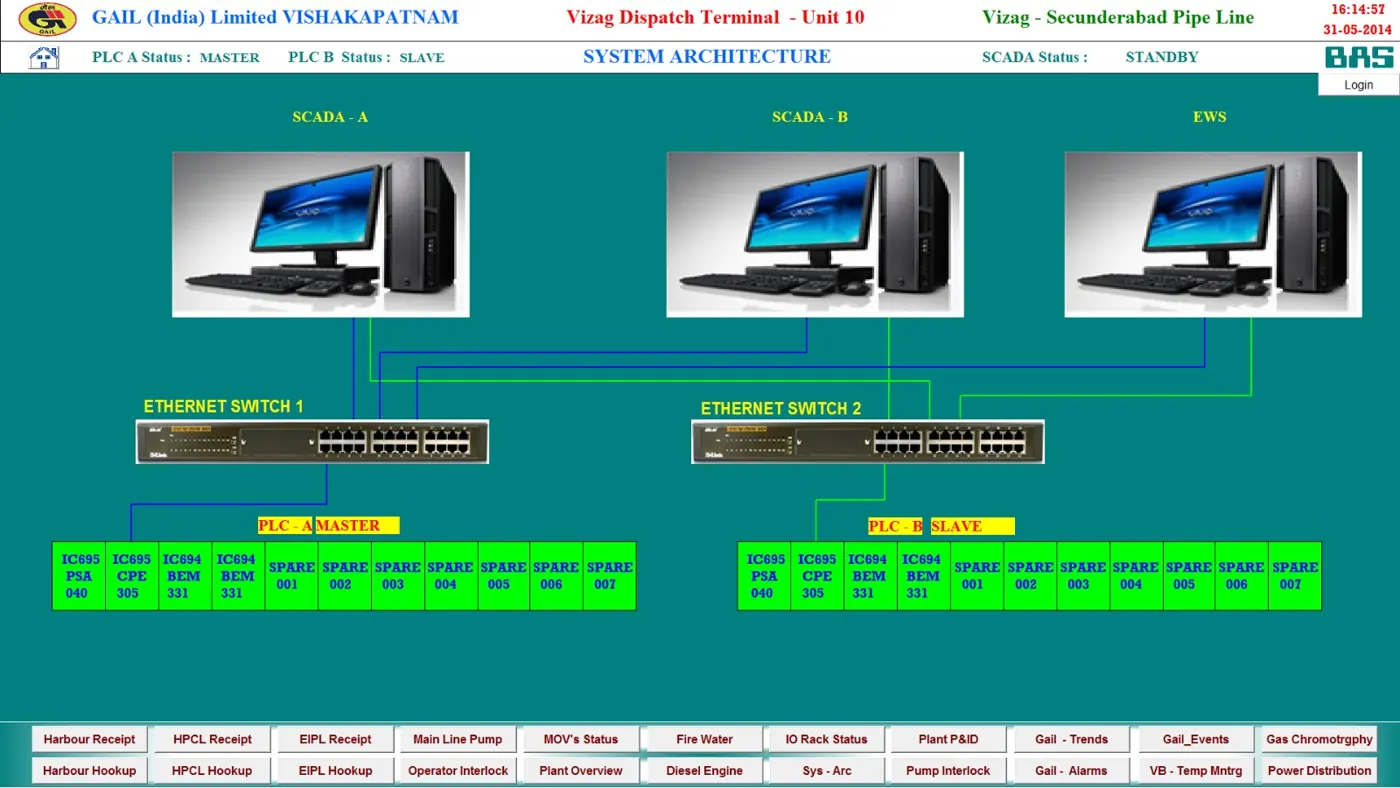
At a pipeline head, a controller failure stops product flow for an entire region. A redundant architecture runs two PLCs and two SCADA nodes in a master and standby pair with the same live database. If the master fails, the standby takes over within the scan time and the operator sees a role switch, not a shutdown.
What we deliver
GE redundant PLC pairs with synchronised logic and I/O diagnostics.
Redundant SCADA servers with automatic failover and a Switch SCADA Role control for maintenance.
Brownfield migration: replacing another make of PLC with GE on a running terminal, cutover planned around operations.
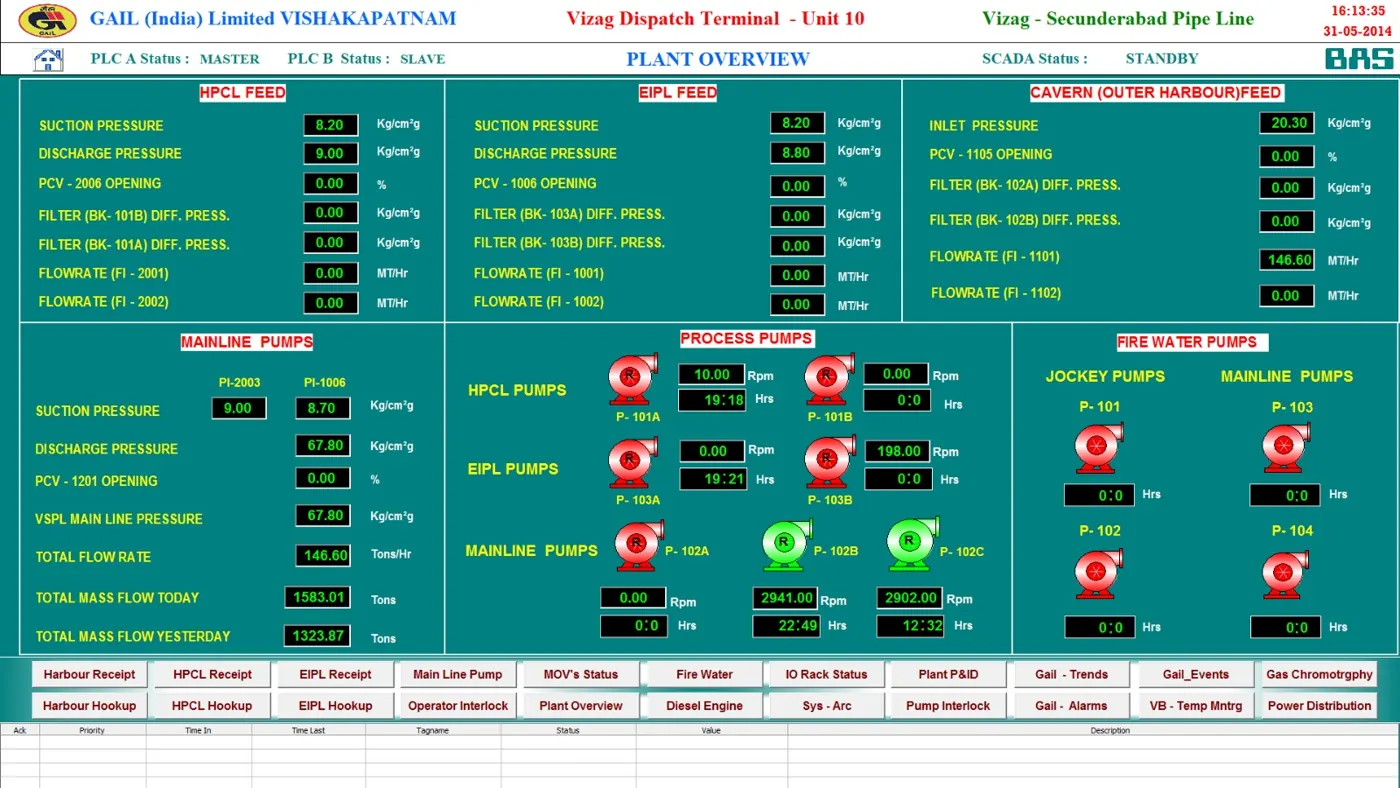
Full terminal screens: harbour receipt, multi-party custody transfer, mainline pumps, interlocks, fire water, gas chromatography, vibration and temperature monitoring, power distribution.
Reference
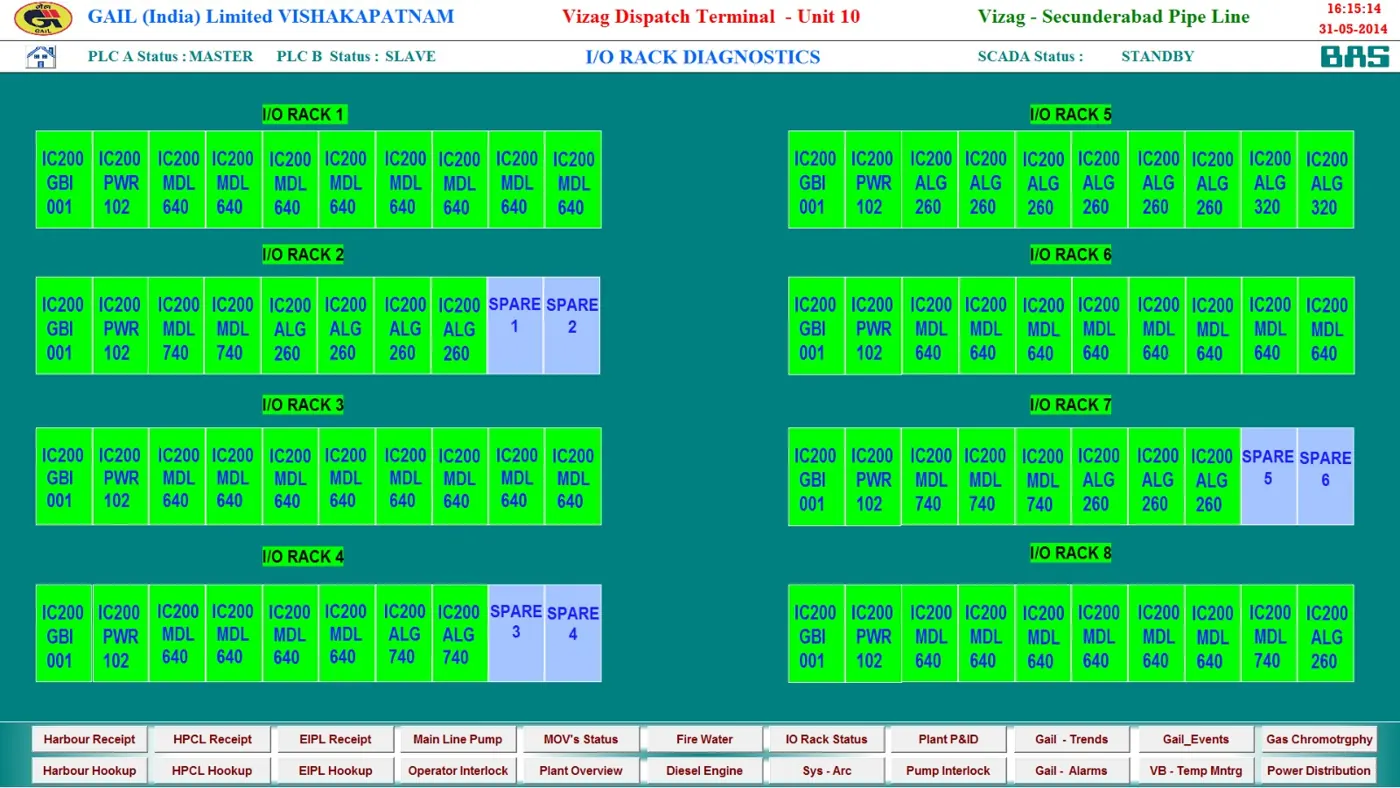
The GAIL dispatch terminal at Visakhapatnam, head of the Vizag to Secunderabad LPG pipeline, where we replaced the existing PLC with GE in a fully redundant configuration and delivered about twenty operator screens.
System architecture, redundant nodesPlant overview, GAIL VizagI/O rack diagnostics
For project heads and buyers
Two controllers and two servers run side by side. If one fails, the other is already running, and the operator sees a notice, not a shutdown.
Why it matters
At a pipeline head or a receipt terminal, an hour of downtime costs more than the redundant hardware. Redundancy is also what the oil companies specify.
What you receive
Redundant GE PLC pair and SCADA server pair
Failover testing with recorded switch times
Migrated screens and tag database
Cutover plan and as-built documentation
Helpful to have
Review of single points of failure
I/O count and network layout
Cutover windows the operation allows
Typical duration
Four to six months for a terminal; cutover itself in planned windows of hours, not days.
How a project runs
Scope callWe go through your P&ID, I/O list or tender clause and agree what the control system has to do.
Technical offerA control philosophy, architecture drawing, bill of materials and price. No surprises later.
Engineering and buildDrawings for approval, PLC logic and SCADA screens built, panels assembled and FAT tested with you present.
CommissioningInstallation supervision, loop checks, start-up and operator training on your site.
SupportDocumentation handover and an annual maintenance contract with a named engineer.
What to send us for a quote
Attach these to your enquiry. The three marked essential are enough for us to start a budget.
Current architecture drawing and known single points of failureEssential
It shows what actually fails today, so redundancy goes where it earns its cost.
I/O count and controller make, model and firmwareEssential
Not every controller can be paired, and some need a replacement first.
Availability target from the tender or the operatorEssential
It sets how fast switchover must be and how much of the system is duplicated.
Network layout: switches, rings, remote I/O and serial links
A redundant controller on a single switch is still a single point of failure.
Existing SCADA version, licences and a tag and screen export
We migrate your screens and tag database instead of redrawing them.
Cutover windows the operation can allow
They set how we stage the changeover and how long each step may take.
Third-party links such as OPC, Modbus gateways and SAP
Every external link has to survive a failover, and we test each one.
Field devices that cannot be duplicated
These stay single, and we need to say so in the offer.
Do not have all of it? Send what you have; we work from a site visit for the rest.
What drives cost and schedule
How much is duplicated
Controllers only, or controllers with network and servers: each layer adds hardware and test time.
I/O count
More I/O means more cabling to move and more points to prove after cutover.
Cutover windows
Short windows mean staged changeovers and more rehearsal, so the job takes longer.
Migration of existing screens and tags
Clean exports save weeks; undocumented screens take longer to rebuild.
Third-party interfaces
Each OPC or Modbus link has to be tested through a failover.
Failover test depth
Recorded switch times at every layer add days and are what an auditor asks to see.
Typical timeline
Review and scope2 to 4 weeksSingle point of failure review and redundancy scope agreed.
Architecture and approval3 to 4 weeksRedundant architecture and cutover plan approved.
Panel build and software6 to 8 weeksRedundant pair built, screens and tags migrated.
FAT and failover testing2 to 3 weeksSwitchover tested at every layer with recorded times.
Staged site installation2 to 4 weeksNew system installed alongside the running one.
Cutover and handover2 to 3 weeksChangeover in planned windows, then as-built documents.
Overall: Four to six months for a terminal; cutover itself in planned windows of hours, not days.
Budget
Every plant is different, so we price from the I/O list and scope rather than a rate card. Send the documents above and you will have a budget figure within a week, and a fixed price after the scope call.
Upgrade of the dispatch terminal at the head of the Vizag to Secunderabad LPG pipeline from another PLC make to GE, in a fully redundant configuration.
Two PLCs and two SCADA nodes in master and standby. About twenty screens: harbour receipt, receipt lines for HPCL, EIPL and GAIL, mainline pumps, interlocks, fire water, gas chromatography, rack diagnostics, vibration and power distribution.
Can you migrate a running plant to a new PLC without a long shutdown?
Yes. We pre-build and test the new system against the existing I/O list, then cut over in planned windows area by area. The GAIL Vizag PLC swap and the ExxonMobil Nigeria upgrade were done this way.