We stay after commissioning. Annual contracts keep systems running, and when a system reaches end of life we migrate it.
Annual maintenance contracts
A control system needs the same care as the plant it runs. Under an AMC we take responsibility for keeping it healthy: scheduled visits, remote support, spares management and a named engineer who knows the plant. We hold AMCs with oil and gas and pharmaceutical sites, including BPCL and Gland Pharma, with iFIX support at plants such as BB Nagar.
Legacy migration
Many plants run SCADA and PLC systems that are no longer supported. We migrate them to current GE iFIX, Cimplicity and PLC platforms while preserving the control philosophy the operators know, with cutover planned around production. References include the GAIL Vizag PLC swap and the ExxonMobil Nigeria GE Fanuc upgrade.
What a migration involves
Survey of the installed system: versions, hardware, licences, spares, undocumented changes.
Conversion of the tag database, screens and logic to the new platform, tested offline against a simulator.
Parallel running where possible, then cutover area by area in agreed windows.
As-built documentation so the next upgrade is easier than this one.
Services
iFIX version upgrades and server hardware refresh.
GE Fanuc Series 90 to current GE PLC migration.
Conversion from other PLC makes to GE.
Cybersecurity hardening: network segmentation, user management, backups.
For project heads and buyers
A named engineer who knows your plant, scheduled visits, and when the old system is no longer supported, a migration with the plant running.
Why it matters
Unsupported SCADA versions and PLCs out of production are the usual cause of a long unplanned outage. An AMC catches it first.
What you receive
Scheduled preventive visits and remote support
Spares and licence management
Migration plan and phased cutover when needed
Backup and cybersecurity hardening
Helpful to have
Inventory of SCADA versions, PLC models and licences
Spares on hand
Shutdown windows available each year
Typical duration
Annual contracts; migrations planned over three to six months.
How a project runs
Scope callWe go through your P&ID, I/O list or tender clause and agree what the control system has to do.
Technical offerA control philosophy, architecture drawing, bill of materials and price. No surprises later.
Engineering and buildDrawings for approval, PLC logic and SCADA screens built, panels assembled and FAT tested with you present.
CommissioningInstallation supervision, loop checks, start-up and operator training on your site.
SupportDocumentation handover and an annual maintenance contract with a named engineer.
What to send us for a quote
Attach these to your enquiry. The three marked essential are enough for us to start a budget.
Inventory of SCADA versions, PLC models, firmware and licencesEssential
It shows what is out of support and what the contract has to cover.
Latest backups of PLC programs and SCADA configuration, with datesEssential
We cannot support what we cannot restore.
Fault and downtime history for the last two yearsEssential
It shows where visits and spares earn their cost.
List of spares on hand and where they are stored
It tells us what to stock, and what to order before it is needed.
Shutdown windows available each year
Preventive work and migrations fit only inside them.
Support hours and response time you need
They set the visit schedule and the cover we propose.
Remote access policy: VPN, IT and OT rules and approvals
Remote support needs an approved path, and that can take weeks to arrange.
Site list, if the contract covers more than one site
Each site adds visits, spares and travel to the plan.
Do not have all of it? Send what you have; we work from a site visit for the rest.
What drives cost and schedule
Number of sites and systems
Each adds visits, spares and travel to the contract.
Age of the installed base
Obsolete controllers and old SCADA versions need more spares and a migration plan.
Response time
Same-day response needs a nearer engineer and a spares stock; next-day costs less.
Visit frequency
Quarterly visits cost more than annual ones but find faults earlier.
Spares holding
Holding spares for you removes lead-time risk but adds to the contract.
Remote access
An approved secure remote link cuts site visits for faults and updates.
Typical timeline
Audit and inventory2 to 3 weeksVersions, licences, backups and risks recorded.
Migration plan and approval2 to 3 weeksPhased plan and shutdown windows agreed.
Build and offline test5 to 8 weeksNew system built and tested off-line against a copy of the old.
Phased cutover2 to 6 weeksSection-by-section changeover with the plant running.
Stabilisation and handover2 to 3 weeksSupport through first operation, then new documents and backups.
Overall: Annual contracts; migrations planned over three to six months.
Budget
Every plant is different, so we price from the I/O list and scope rather than a rate card. Send the documents above and you will have a budget figure within a week, and a fixed price after the scope call.
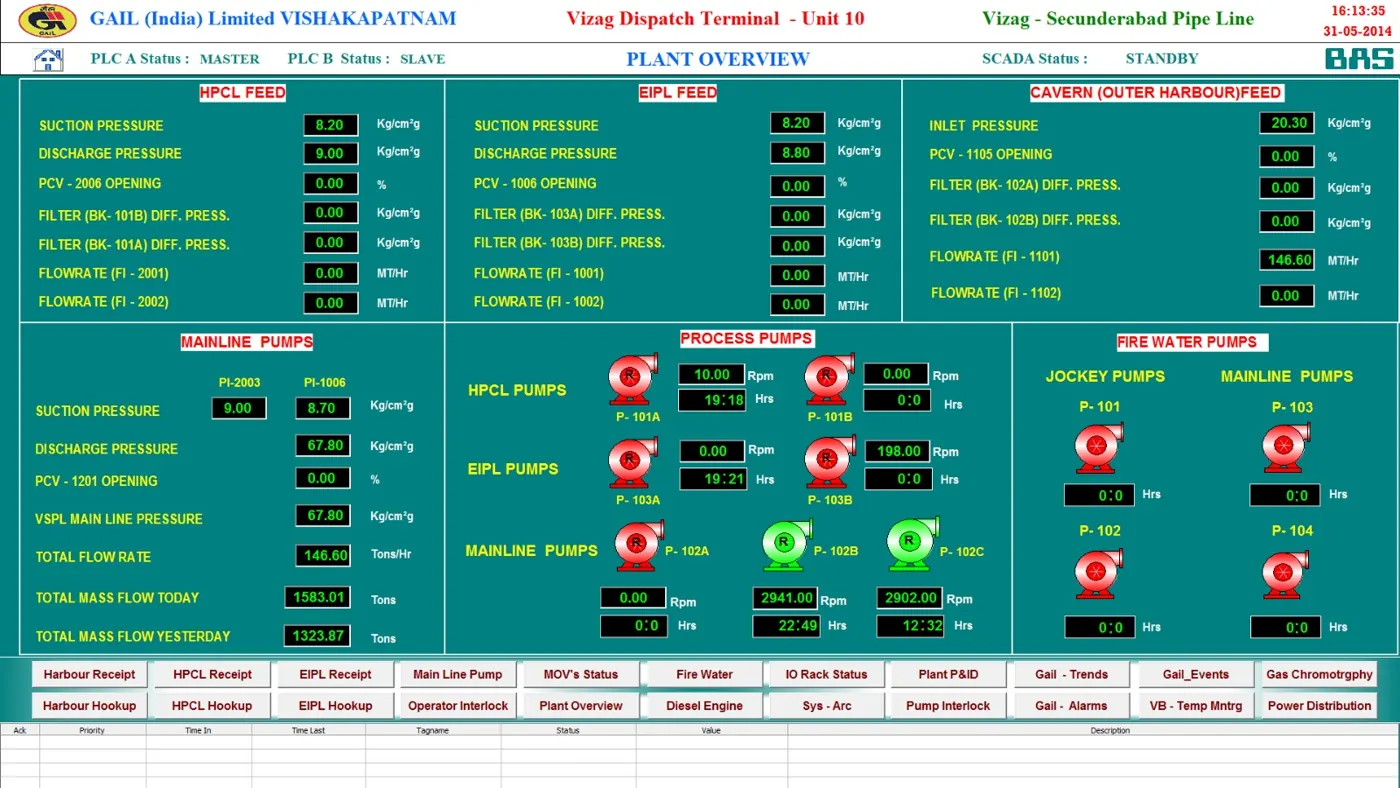
Upgrade of the dispatch terminal at the head of the Vizag to Secunderabad LPG pipeline from another PLC make to GE, in a fully redundant configuration.
Two PLCs and two SCADA nodes in master and standby. About twenty screens: harbour receipt, receipt lines for HPCL, EIPL and GAIL, mainline pumps, interlocks, fire water, gas chromatography, rack diagnostics, vibration and power distribution.