
OISD-STD-214 signal sharing
How an LPG bottling plant or terminal on a cross-country pipeline shares live data with the pipeline, which signals go across, and how the interface is built. Written from our work at IOCL Kalyani and the GAIL Vizag terminal.
What OISD-STD-214 is
OISD-STD-214 is the Oil Industry Safety Directorate standard for cross-country LPG pipelines. When a bottling plant or terminal takes LPG straight from such a pipeline, the two operate as one system: the pipeline pumps, and the plant receives the product into its storage. Neither side can run safely without seeing the other, so live data is shared between the plant's control system and the pipeline's.
Why the data has to be shared
- The pipeline must know the plant can accept product: space in the receiving vessel and the receipt valves open.
- The pipeline must stop pumping when the plant goes to emergency shutdown or detects fire or gas.
- The plant must see the pipeline's own shutdown status.
- Both ends need the same measured receipt, so stock and invoicing agree.
The signals that go across
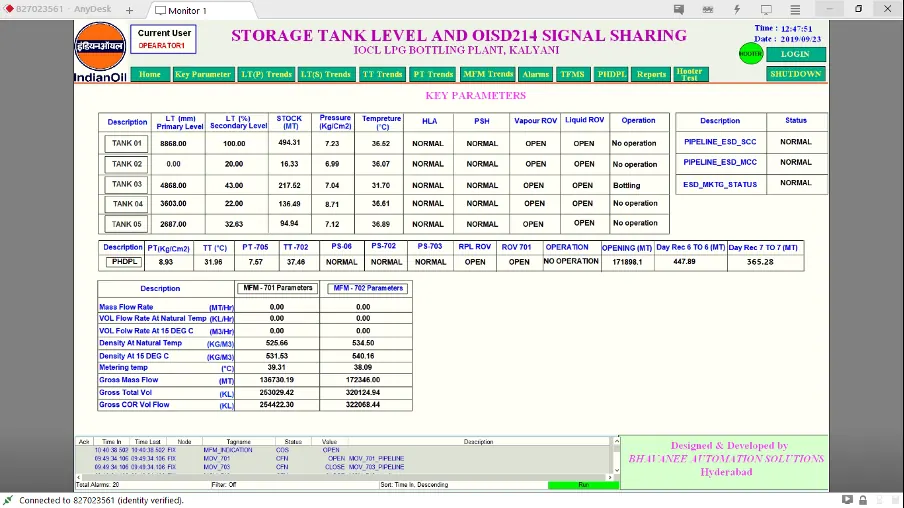
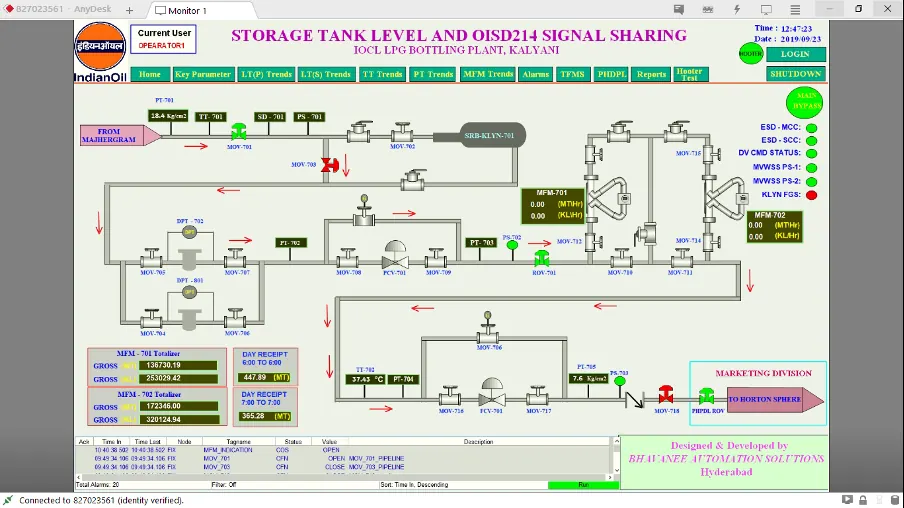
The exact list comes from the pipeline owner's interface specification. This is the list on the signal sharing screen we built for IOCL's LPG bottling plant at Kalyani, which receives from IOCL's PHDPL pipeline.
- Storage
Plant to pipeline For every bullet or sphere: primary and secondary level, stock in tonnes, pressure, temperature, high level alarm and high pressure switch, and whether the vessel is receiving or in bottling.
- Valves
Plant to pipeline Liquid and vapour ROV position on each vessel, the receipt ROV, and the MOVs on the receipt line.
- Receipt line
Plant to pipeline Receipt pressure and temperature, pressure switches, and filter differential pressure.
- Metering
Plant to pipeline From each mass flow meter: mass flow, volume flow at natural temperature and at 15 °C, density, metering temperature and gross totals. Opening stock and day receipt for the agreed accounting day.
- Safety
Plant to pipeline Plant ESD status, fire and gas system status, and water spray system pressure switches, so the pipeline can stop pumping when the plant cannot receive.
- Pipeline status
Pipeline to plant The pipeline's ESD status from its control centre and the marketing ESD status, shown to the plant operator on the same screen.
How the interface is built
- 1. Agree the signal list
Start from the pipeline owner's interface specification and the plant's I/O list. Every shared point gets a tag, a range, units and a direction.
- 2. Measure what is missing
Where a required signal is not measured today, such as a secondary level or a pressure switch, add the instrument and wire it to the PLC.
- 3. Build the interface
The PLC and SCADA collect the signals and hand them to the pipeline's RTU or SCADA over the link and protocol the pipeline specifies. Communication failure raises its own alarm, so stale data is never mistaken for live data.
- 4. Give operators the same view
A dedicated signal sharing screen shows exactly what the pipeline sees, with the pipeline's ESD status beside it. Every alarm and change is time stamped.
- 5. Test end to end
Each point is checked from the field device to the pipeline end before cutover, so both control rooms agree on every value.
Where we have done it
IOCL Kalyani, West Bengal. Turnkey automation of the LPG bottling plant on GE iFIX, with every storage, receipt, metering and safety signal above shared with the pipeline, and the pipeline's ESD status shown to the plant.
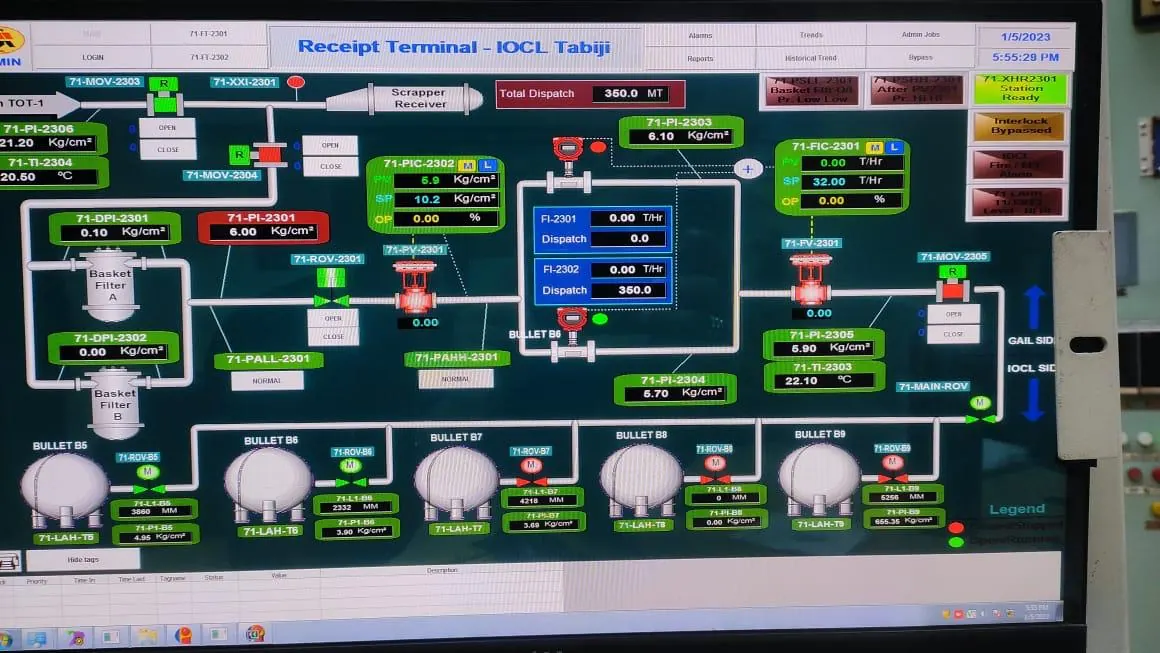
GAIL Vizag dispatch terminal. The terminal at the head of the Vizag to Secunderabad LPG pipeline, on redundant GE PLCs and SCADA, shares its live data with the pipeline under OISD-STD-214.
Signal sharing is one part of our LPG bottling plant automation, alongside fire and gas systems and custody transfer metering.
This page explains how the interface works in practice. For the requirements themselves, refer to the current edition of OISD-STD-214 published by the Oil Industry Safety Directorate and to the pipeline owner's interface specification.
Common questions
What is OISD-STD-214?
OISD-STD-214 is the Oil Industry Safety Directorate standard for cross-country LPG pipelines. It covers how these pipelines are designed, built, operated and maintained, including the terminals and bottling plants that receive LPG from them.
Does every LPG bottling plant need OISD-214 signal sharing?
No. It applies where a plant or terminal is connected to a cross-country LPG pipeline and receives product from it. A plant supplied only by tank trucks has no pipeline to share data with.
Which signals are shared?
The exact list comes from the pipeline owner's interface specification. Typically it covers storage vessel levels, pressures, temperatures and stock, high level and high pressure alarms, receipt and vessel ROV positions, receipt line pressure and temperature, mass flow meter data and day receipt, and the plant's ESD and fire and gas status. The pipeline sends back its own ESD status.
Can signal sharing be added to a plant that is already running?
Yes. The interface is added to the existing PLC and SCADA, tested against the agreed signal list, and cut over in a planned window, so the plant keeps operating.
Do we need to replace our SCADA to do this?
Usually not. If the plant already has a PLC and SCADA such as GE iFIX, the shared signals are mapped from it and handed to the pipeline over the link the pipeline owner specifies. New instruments are only needed where a required signal is not measured today.